Costs
Part of Best quote context and sources for 2027: a ranked shortlist
Why a search returns nothing: what quote corpora cover and where they stop
A practical guide to quote corpora: what newspaper, book and archive collections cover, where their gaps and text recognition fail, and how to state a null result.
A search that returns nothing has told you about the archive, not about the past. That sentence is the whole of this page.
Most people checking a quotation treat the corpora they search as a window onto everything ever printed. They are not. Each is a specific pile of paper, assembled for a specific reason, digitized to a specific standard, and missing enormous amounts on purpose.
Knowing the shape of the holes is what separates a finding from a guess.
What to take away
- Every corpus has a stated scope and an unstated one, and the gap between them is where errors live.
- The middle of the twentieth century is the hardest period to check, and the reason is legal rather than technical.
- Text recognition quality varies enormously by format and decade, so a phrase can be present and unfindable.
- Write down which corpora you searched. That list is part of your result.
Four kinds of corpus, and what each one is for
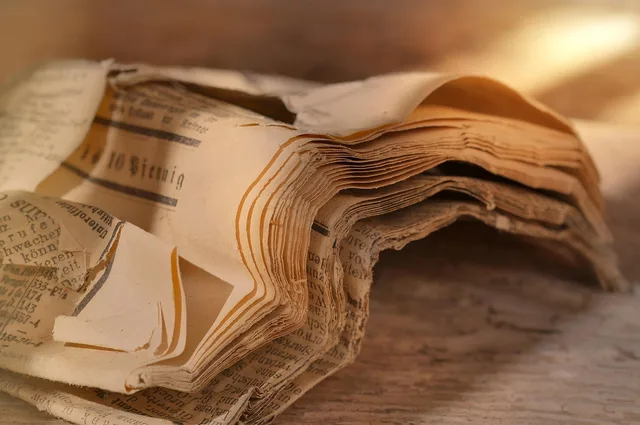
Digitized newspapers. The best tool for dating a popular phrase, because newspapers printed filler, jokes, sermon extracts, and platitudes in volume, and printed them fast. If a saying was circulating, a newspaper carried it. The Library of Congress research guide to its historical newspaper collection is the clearest statement of how such a collection is built: selected titles, selected states, selected date ranges, funded in tranches. It is not every newspaper. It is not close. The corpus itself is named Chronicling America, and its coverage runs from selected U.S. titles starting in 1690 to a hard stop in 1963.
Four Corpus Types and Their Uses
Digitized newspapers
- Best for
- Dating popular phrases
- Depth
- Fast, high volume
- Coverage limit
- Selected titles only
- Main obstacle
- Recognition errors
Scanned books
- Best for
- Earliest anonymous version
- Depth
- Deep 18th-19th c.
- Coverage limit
- Shallow after 1900
- Main obstacle
- Copyright
Official proceedings
- Best for
- Verbatim public record
- Depth
- Continuous, dated
- Coverage limit
- One chamber only
- Main obstacle
- Narrow scope
Archival catalogs
- Best for
- Locating manuscripts
- Depth
- Pointers only
- Coverage limit
- No full text
- Main obstacle
- No searchable text
Scanned books. Deep for the eighteenth and nineteenth centuries, shallow and legally constrained afterward. Book corpora are where you find the sermon, the schoolbook, or the anthology that a line actually came from, and they are the usual home of the earliest anonymous version. HathiTrust and Google Books are the two largest. HathiTrust offers full text for public domain works, which in practice means most pre-1928 books, and search-only for in-copyright works. Google Books is larger but gives snippet view for most in-copyright titles and has no reliable date sorting.
Official proceedings. Where public business generates a verbatim record. The bound Congressional Record collection is one example of the type: a continuous, dated, searchable record of what was said in a specific chamber. Records like these are unusually good evidence, and unusually narrow in what they cover.
Institutional and archival catalogs. These do not usually give you full text. They tell you that a manuscript, a letter, or a recording exists, and where it is. The National Archives library information service is a reference point for how such finding aids are organized. A catalog entry is often the last step you can take from a desk.
JSTOR is a corpus of scholarly journals, with a moving wall that typically excludes the most recent three to five years, and it contains no newspapers.
What each one cannot show you
- Anything never printed. Conversation, lectures without a stenographer, and most private speech leave no record at all, which is why so many attributed remarks are unfalsifiable rather than false.
- Anything printed in a title the project did not select. Small papers, foreign-language papers, and trade press are thinly covered nearly everywhere.
- Anything still in copyright, in full text, in most book corpora. You may get a snippet or a page count and nothing you can read.
- Anything the text recognition mangled. A phrase set in a tight column on browned newsprint can be perfectly present on the page and absent from the index.
That last point is worth taking seriously rather than nodding at. Automated text recognition on nineteenth-century newsprint routinely produces word error rates that make exact-phrase search unreliable. The words are there. The index does not have them.
What Corpora Cannot Show You
- Speech never printed leaves no record
- Titles the project did not select
- Full text still under copyright
- Pages mangled by text recognition
- Word error rates break exact-phrase search
Mid-century copyright gaps
Coverage is not evenly bad. It has a shape, and the shape is roughly this: strong before the early twentieth century, thin from then until the point where publishing went digital, strong again afterward.
Coverage Shape Over Time
- Before 1900Good full text, poor recognition
- Early to mid 1900sPatchy, often snippet only
- Late 1900sCatalogs and indexes, limited text
- Digital eraAbundant text, no stable chronology
| Period | Typical availability | Main obstacle |
|---|---|---|
| Before 1900 | Good full text, poor recognition quality | Scan and print quality |
| Early to mid twentieth century | Patchy, often snippet only | Copyright status |
| Late twentieth century | Catalogs and indexes, limited text | Copyright and licensing |
| Digital era | Abundant, poorly dated | No stable chronology |
The middle two rows matter most, because that is exactly when a great many attributed lines entered circulation.
The digital era has the opposite problem. There is far too much text and almost no trustworthy dating. Pages are edited in place, timestamps are assigned by systems rather than by publication, and copies travel faster than originals.
Chronology, which is the only thing a quotation check really needs, is the one thing the open web does not supply. The method for working from earliest appearance rather than most appearances depends on having a corpus that can be sorted by date at all.
Reading a null result properly
When a search returns nothing, write the sentence that actually follows from it. Something like: the phrase in this wording does not appear in these named corpora, over these date ranges, subject to their recognition quality. That is a real, limited, defensible claim.
Then consider the ordinary reasons a present phrase goes missing:
Why a Present Phrase Goes Missing
- Search a shorter, duller fragment
- Check changed spelling or hyphenation
- Consider a translated original
- Suspect recognition failure on the page
- Check corpus title, region, years
Here is one worked example. A page states the claim as: "Sherlock Holmes says 'Elementary, my dear Watson' in the original stories by Arthur Conan Doyle." We search the Conan Doyle canon in full text through Project Gutenberg and HathiTrust. The exact phrase returns nothing.
The null result reads: the phrase "Elementary, my dear Watson" does not appear in the Conan Doyle canon as searched in these two corpora. That is a real finding. It does not prove the phrase was never written. It proves the phrase is absent from that specific corpus. The line does appear in later film and radio adaptations.
Working through that list before concluding anything is most of what separates careful checking from confident nonsense. Our account of how transmission damages wording covers the first three of those in detail, and the material on where specialist records live covers the case where the right corpus is a professional one rather than a general one.
Building a list you can reuse
Keep a short written list of the corpora you use, with three notes against each: what it covers, what it stops at, and how good its text recognition is. Five entries is plenty.
| Corpus | Covers | Stops at | Recognition quality |
|---|---|---|---|
| Chronicling America | Selected U.S. newspapers, 1690 to 1963 | 1963 | Poor on 19th-century newsprint |
| HathiTrust | Digitized books and journals from research libraries | Full text mostly pre-1928; search-only after | Good on clean print |
| Google Books | Massive scan of published books | Snippet view for most in-copyright; no reliable date sort | Mixed |
| JSTOR | Scholarly journals | Moving wall, typically last 3 to 5 years excluded | High |
| Congressional Record | U.S. congressional proceedings | Publication lag; bound edition | Good, but narrow scope |
The value is not the list itself but the habit of naming your coverage when you report a result. It forces the limits into the open where a reader can weigh them.
Add one line about what you would search next if the question mattered more. That sentence is often the most useful part of a negative finding. It tells the next person where the unexplored ground is.
The history of how earlier collections were assembled is worth reading alongside this. Old printed collections are themselves a corpus with a coverage statement, and a badly behaved one.
Common questions
Which corpus should I search first?
Newspapers, almost always, for anything that circulates as a saying. They are dense, dated, and biased toward exactly the short quotable material that gets misattributed. Books first only when you already have a candidate work to look inside.
Is a paywalled archive worth paying for?
For one line, no. Public libraries commonly provide access to subscription newspaper and periodical archives with a library card, such as ProQuest and Newspapers.com, which is the cheapest route by a wide margin and the one most people forget exists.
How much does bad text recognition really matter?
Enough to change your conclusion. Treat a single null result on a scanned corpus as weak, and try at least two different fragments of the line before you believe it.
If the corpus lets you browse the page image by date, and you have a candidate date, reading the page directly is worth more than any number of failed searches.
What if the archive is not in English?
Then the search has to be, at least in part. A line that reads as translated should be searched in its likely original language, because the English wording is the translator's and may match nothing anywhere.