Guides
How Philadelphia archives document Founding-era quotes
Philadelphia holds the drafts, letters and newspapers behind the Declaration and Constitution, which is what lets you test a Founding-era quotation.
What to take away
- A quotation check proves four things at oncespeaker, document, wording, date. Miss one and you have a citation problem, not a quotation.
- The National Archives publishes free transcriptions of the Declaration, the Constitution, the Bill of Rights and the Articles of Confederation. Read those before anything else.
- Philadelphia repositories hold the drafts, letters and newspapers that explain what a line meant before later editors tidied it up.
- Smithsonian object and portrait records date a quotation and show who was in the room, which is often the missing piece.
- Most bad Founding-era quotations fail the same six wayswrong speaker, wrong document, edited wording, invented date, stripped context, or a citation loop that never reaches paper.
What a quotation check actually has to prove
You are not checking spelling. You are proving that a named person wrote or said specific words, in a specific document, at a specific time.
Four Elements of a Quote Check
- Speakernamed person
- Documentspecific source
- Wordingexact words
- Datespecific time
Four elements have to line up: speaker, document, wording, date. Any one missing turns the quotation into a citation problem.
A line reprinted in a textbook or on a quote site proves only that someone else repeated it. That is the starting point, not the evidence. When the print record is all you have, the method in humorous quotes source check applies to any era.
Founding-period sources come in four groups: official texts, drafts and working papers, private letters, and newspapers printed at the time. Philadelphia is unusually well supplied with all four, because the Continental Congress and the Constitutional Convention both met there. The paperwork stayed near where it was made.
Match the source to the claim. A question about what the Constitution says needs the Constitution. A question about what a delegate thought needs a letter or a diary.
Spoken quotations drift most. Speeches of the 1770s and 1780s were often written down later, from memory or a reporter's notes, and those notes disagree with each other.
The National Archives texts, and why Philadelphia researchers start there
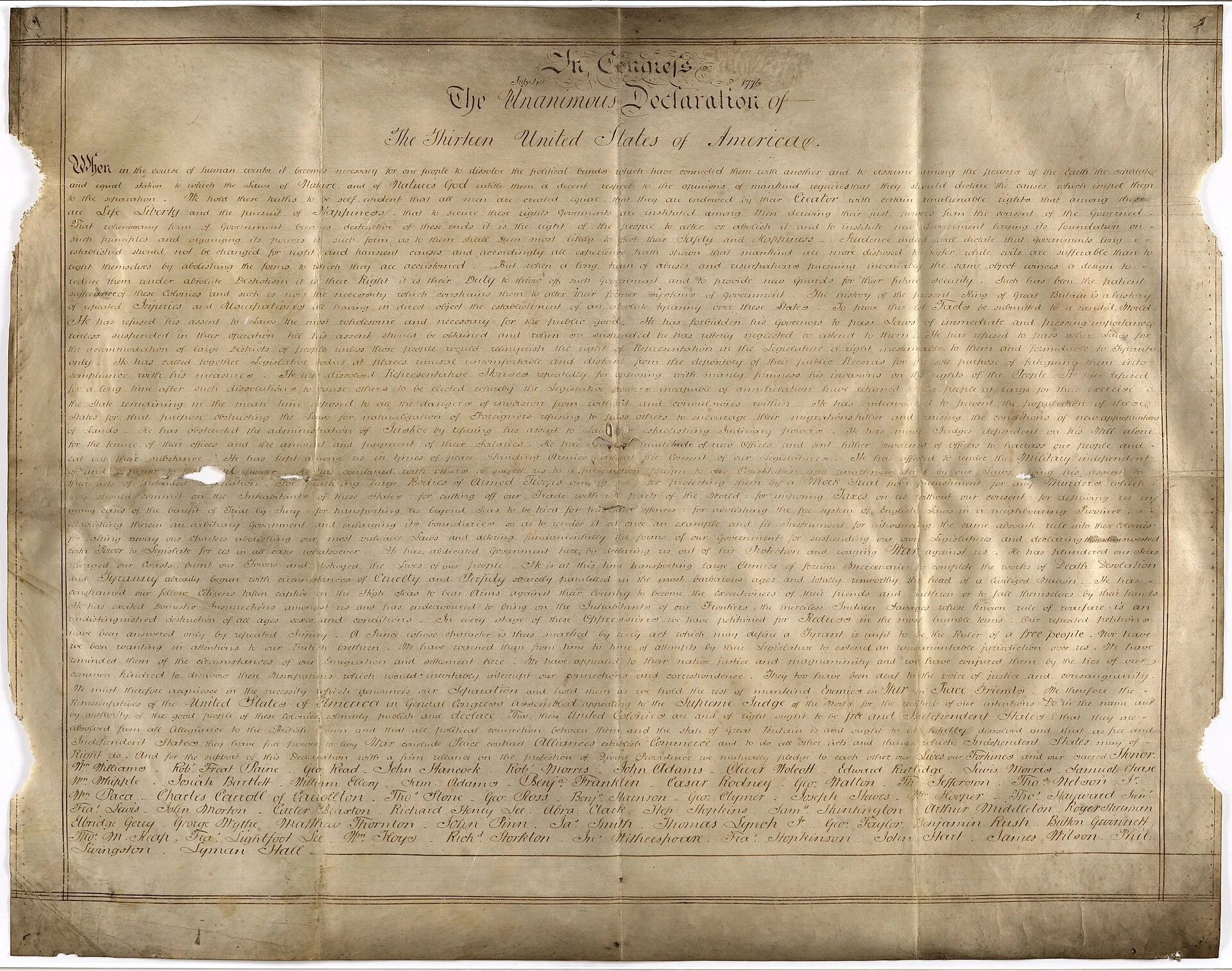
The National Archives and Records Administration holds the engrossed originals and publishes reliable transcriptions. Its founding documents verification page is the standard first stop.
Check the opening or the grievances against the Declaration of Independence text. It is short enough to read in full, which is the point.
Wording questions about the frame of government go to the Constitution text. Quote sites routinely blur the preamble and the enumerated powers of Congress.
Rights claims are the most misquoted of all. The Bill of Rights text shows the amendments numbered separately from the original articles, a distinction most quotations lose.
Material from the 1770s and 1780s often traces to the Articles of Confederation, the framework that preceded the Constitution. Some quotations credit the later document for words that belong to the earlier one.
The Philadelphia connection is direct. The Declaration was adopted in the Pennsylvania State House, now Independence Hall, and the Constitution was drafted in the same building in 1787. The originals left the city long ago and sit in Washington, D.C.
Philadelphia collections that hold the paper trail
Published transcriptions answer wording questions. Manuscripts answer everything else: who wrote first, what got cut, and when the line changed.
Philadelphia Collections at a Glance
Collection
- American Philosophical Society
- Franklin papers, correspondence
- Historical Society of Pennsylvania
- Manuscripts, family papers
- Library Company of Philadelphia
- Early printed books, newspapers
- Independence National Historical Park
- Site records, object files
- Free Library of Philadelphia
- Printed editions, newspaper microfilm
Strength for quote work
- American Philosophical Society
- Historical Society of Pennsylvania
- Library Company of Philadelphia
- Independence National Historical Park
- Free Library of Philadelphia
| Collection | Strength for quote work | Access route |
|---|---|---|
| American Philosophical Society | Scientific and political correspondence, including Franklin papers | Reading room by appointment |
| Historical Society of Pennsylvania | Manuscripts, broadsides, family papers | Onsite, some digitized |
| Library Company of Philadelphia | Early printed books, pamphlets, newspapers | Onsite catalog and reading room |
| Independence National Historical Park | Site records and object files tied to Independence Hall | Park archives, ranger inquiries |
| Free Library of Philadelphia | Printed editions and microfilm of early newspapers | Public reading rooms |
The Historical Society of Pennsylvania is the usual first stop for manuscript questions. Its catalog entries name the correspondent, the place and the date, which is exactly what a citation needs.
The Library Company dates to 1731 and collects the printed matter of the period. If a quotation appears in a pamphlet or an almanac, this is where the printing can be confirmed.
The American Philosophical Society holds the largest body of Benjamin Franklin's papers in the country. Franklin is quoted constantly, and a large share of those quotations cannot be found in his surviving writing.
For anything tied to Independence Hall itself, park collections connect objects and documents to specific rooms and events. That helps when a quotation is attributed to a moment rather than a page.
What Smithsonian records add
The Smithsonian Institution supplies a different kind of evidence: portraits, flags, printing equipment and personal objects that date a quotation and confirm who was present.
The National Museum of American History holds political objects from the early republic alongside the Star-Spangled Banner. Those records set a documentation standard worth copying.
Smithsonian strength is material culture. If a quotation is attached to a desk, a pen or a broadside, the object file can confirm the story or break it.
Portraits matter more than they seem. A likeness painted decades after the fact is a reconstruction, and quotations hung on such images usually share the same weak footing.
When a museum record and a quote site disagree, treat the museum record as the stronger signal and go find the document underneath.
Requesting material without leaving your desk
Most checks never require a trip. Work remote first, then request only what exists on paper alone.
Remote Quote Check Workflow
- Copy exact wording from National Archives
- Search Philadelphia online catalogs by speaker and date
- Check Smithsonian online collections for objects
- Email reference staff a narrow question
- Request scan or reading-room visit for undigitized items
Reference staff answer narrow questions faster. Ask whether a phrase appears in a named collection, not whether it is real. Manuscript requests can take days or weeks, and some collections require an appointment before staff pull materials.
A worked example
Suppose a quotation is credited to a delegate in 1776, on the right to rebel.
Search the Declaration text for the phrase. If it is absent, the claim has failed at the document level.
Search the delegate's published correspondence. If the phrase turns up only in a nineteenth-century biography, you have found the likely source of the error.
Check the date. A letter written after the event it describes is a recollection, not a record.
Write down what you found. A citation saying the phrase appears in a later biography is honest and useful, even when it disproves the popular version.
Six failure patterns, and how to catch each
- Wrong speaker. A line by a lesser-known writer gets attached to Washington, Franklin or Jefferson because the famous name travels better.
- Wrong document. Words from the Articles of Confederation are credited to the Constitution, or the reverse.
- Edited wording. Archaic spelling and punctuation have been modernized, or a qualifier dropped.
- Invented date. A line written years later is presented as a contemporary remark.
- Stripped context. A private opinion is presented as a public position.
- Circular source. Two quote sites cite each other, and neither cites a document.
The loop is the hardest to see. A citation chain can look impressive while never touching paper, the trap described in inspirational quotes source check.
Six Failure Patterns to Catch
- Wrong speaker
- Wrong document
- Edited wording
- Invented date
- Stripped context
- Circular source
Wording changes fall fast once the official text is open. Read the quotation aloud against the transcription and mark every difference, spelling included.
Attribution errors take longer. Search the phrase in a full-text database of early American newspapers and correspondence before you accept a famous name.
Context errors are the subtlest, because the wording can be exact and the meaning still wrong. That check needs the quote context and sources around the line, not the line alone.
Short quotations are the most vulnerable, since there is less wording to test. A four-word phrase can survive decades of repetition untested, as this piece on life quotes source check shows.
Ask finally whether the line sounds like the period. Vocabulary and sentence rhythm shifted between 1776 and 1800, and a modern-sounding line deserves extra scrutiny.
When a quotation passes, record the document, the page or entry, the repository and the date you checked it. That record turns a plausible line into a citable one, and it is the habit that separates a source check from a guess.
Common questions
Why does Philadelphia matter for Founding-era quotations?
The Declaration and the Constitution were debated and signed there, so the city's institutions hold drafts, letters and newspapers from the same years. That local paper trail is what lets you test a quotation instead of repeating it.
Can I check a quotation without visiting Philadelphia?
Yes. The National Archives publishes the full texts of the Declaration, the Constitution, the Bill of Rights and the Articles of Confederation, and most Philadelphia repositories have online catalogs. Email reference staff for anything not digitized.
Which document should I check first?
Check the document the quotation claims to come from. If the phrase is not in the Declaration, the Constitution or the Bill of Rights, move to correspondence and newspapers before accepting the attribution.
Why do so many Franklin quotations fail?
Franklin wrote constantly and was quoted constantly, and later writers borrowed his name for lines he never wrote. His surviving papers are large enough that a genuine line usually can be found.
What belongs in a finished citation?
The speaker, the document or collection, the repository, the date of the item, and the date you checked it. If the quotation survives only in a later biography, say so plainly.