Guides
How to verify a political quote in the Congressional Record
Trace a political quote through GovInfo, committee hearing transcripts, National Archives holdings and FEC filings before you print or repeat it.
What to take away
- The Congressional Record is the official account of floor proceedings, but members may revise remarks before publication, so it is not a verbatim transcript.
- Search GovInfo by speaker surname and a date range, then save the PDF and record volume, page, column and date.
- Committee hearings, the National Archives catalog and FEC filings each cover speech the Record does not.
- A remark inserted into the Extensions of Remarks was never spoken aloud. Check before you call it a floor quote.
- Quote-aggregator sites copy one another, so a single misdated speech spreads to dozens of pages.
What the Congressional Record is, and what it is not
The Congressional Record is the official account of debate and proceedings in the House and Senate. The Government Publishing Office issues it each day Congress meets, then binds the issues into permanent volumes. Federal works carry no copyright, so a floor statement can be quoted at length.
Congressional Record vs. Court Transcript
Congressional Record
- Revision
- Members may revise
- Insertions
- Extensions not spoken
- Page numbers
- H for House, S for Senate
- Copyright
- Federal works, no copyright
- Daily summary
- Daily Digest opens issue
Court Reporter Transcript
- Revision
- Verbatim, no revision
- Insertions
- Only spoken words
- Page numbers
- Sequential, no chamber code
- Copyright
- May be protected
- Daily summary
- No digest
It is not a court reporter's transcript. Members may revise their remarks before publication, correcting grammar or adding material they never said. That revision right is the single most common reason a quote on a quote site does not match the spoken word.
Each issue opens with a Daily Digest summarizing the day. Page numbers tell you the chamber: House pages carry an H, Senate pages carry an S. A citation of volume, page, column and date points an editor straight at the passage.
The Record also carries the Extensions of Remarks at the back, where members insert statements never delivered aloud. Those insertions get quoted as speeches constantly. Confirm whether a line was spoken or inserted before you attribute it to a live floor moment.
Before the modern Record, debate sits in the Congressional Globe, the Register of Debates and the Annals of Congress. Those series are indexed differently and often paraphrase. Cite them, but say in your citation that they are not verbatim.
Searching GovInfo by speaker and date
GovInfo is the Government Publishing Office's free portal for federal documents. Its Congressional Record collection covers recent decades in full searchable text, and volumes from 1873 to 1993 are reachable through the Library of Congress. Open the GovInfo Congressional Record collection and filter by date or browse by Congress and session. Both paths reach the same daily issues.
For a named speaker, use advanced search. Enter the member's surname, set a date range, and limit to one chamber if you know it. A topic keyword works when you do not know who spoke.
The Record is paginated by volume, not by speaker, and one daily issue can run several hundred pages. Name plus date narrows that fast.
- Open the GovInfo Congressional Record collection.
- Filter by date or browse by Congress and session.
- Open advanced search and enter the member's surname with a date range.
- Limit the results to House or Senate if you know the chamber.
- Download the PDF and record volume, page, column and date.
GovInfo search sequence
- Open GovInfo Congressional Record collection
- Enter speaker surname and date range
- Scan results for bill or topic
- Open PDF and read whole column
- Write volume, page, column, date
If nothing turns up, widen the range by a week. Members often speak on a bill days before a vote. Then check the Extensions of Remarks at the back of the same issue.
Watch name variants. A member may appear as Rep. or Mr. followed by a state. Search the surname alone first, then add the state to filter out colleagues who share it.
Download the PDF rather than the plain text, and keep the page number with your notes.
For an illustrative trace, suppose a search hit returns a 2019 Senate issue. The PDF opens on page S1234, column 2. The citation reads 165 Cong. Rec. S1234, col. 2 (daily ed. Jan. 3, 2019). Treat those numbers as placeholders; the PDF supplies the correct volume, page, column and date.
For how a citation chain collapses across secondary sources, see this quote verification app review.
Committee hearings, where the real exchange lives
Hearings carry much of Congress's substantive work. Witnesses testify under oath and members question them. The sessions are transcribed and published separately from the Record, so a floor-only search misses them entirely.
Hearing source decision
Quote attributed to a witness?
Start with prepared statement
Use hearing transcript
A quote that comes from a question or an answer lives here, not on the floor. The transcript captures interruptions and follow-ups that change what a line means. GovInfo hosts hearings too, searchable by committee, witness or subject.
Prepared statements are written in advance. Transcripts show what was said in the room. If a quote is attributed to a witness, start with the prepared statement. If it comes from back-and-forth, use the transcript. Transcripts are lightly edited for clarity, so small differences from the spoken word are normal.
Markups and conference reports add another layer. A markup shows how a bill changed and who pushed each change. A conference report reconciles the two chambers and records where each version differed before the final text was agreed.
Hearing records also show a member's position over time. A senator may criticize a bill in committee and vote for it a month later.
A quote site keeps whichever version sounds sharper and drops the other. Cite the hearing title, committee and date every time.
For a scored look at how these records hold up, see this quotes by profession guide.
National Archives holdings and Citizen Archivist transcriptions
The National Archives and Records Administration holds federal records Congress does not. Presidential papers, agency correspondence and court files sit in its collections, which matters for quotes from before the modern Record format.
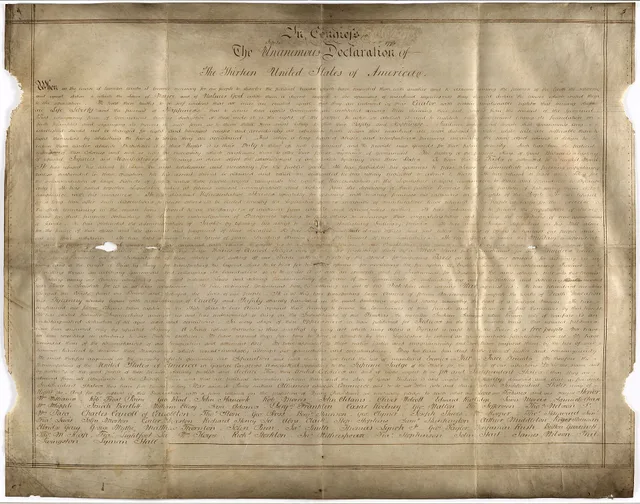
Research Our Records | National Archives covers presidents, cabinet officers and agencies. Search the catalog by name, date or subject before concluding a quote is unverifiable. The flagship building on Pennsylvania Avenue in Washington, D.C., holds the Declaration of Independence, the Constitution and the Bill of Rights.
The Citizen Archivist | National Archives program lets volunteers tag and transcribe records, which makes scanned or handwritten pages searchable. If the catalog search comes up empty, a transcription may already exist.
Say a quote is attributed to a 19th-century senator and survives only in a letter the Archives holds. A volunteer may have typed it out. That transcription is a finding aid, not the original. Open the scan and read the handwriting.
Presidential libraries are part of the same system, holding tapes, speech drafts and staff memos. A draft shows which lines were cut before delivery, which matters when a famous quote was written but never spoken.
Note the collection number, then request the item or open the digital copy. Cite collection, box and folder when you can.
For where verification fails and why the failures repeat, see this best inspirational quotes checklist.
FEC filings for campaign speech
The Federal Election Commission regulates campaign money and publishes what it collects. Its Legal resources explain the rules on campaign speech and communications. Its Campaign finance data | FEC shows donors, committees and spending. The commission is headquartered in Washington, D.C., near the Capitol complex.
FEC filings vs. floor speech
FEC Filing
- Speech type
- Campaign rally or fundraiser
- Evidence
- Expenditures, vendor payments
- Legal rules
- Advisory opinions, enforcement
- Reporting forms
- Independent expenditures, coordinated
Congressional Record
- Speech type
- Floor debate or insertion
- Evidence
- Volume, page, column
- Legal rules
- Not covered
- Reporting forms
- Daily Digest, Extensions
A quote from a rally or a fundraiser can often be matched to a filing. Committees report expenditures for events, travel and advertising, so a speech shows up as a rally cost or a media buy.
Advisory opinions and enforcement actions restate facts and quote candidates and committees directly, which is useful when a quote concerns campaign law rather than policy.
Start with the legal resources for a quote about finance rules, then pull the committee's filings. Together they show the statement and the money behind it, the part a quote site never carries.
Not every political quote has an FEC record. Only campaign-related speech does. A floor speech belongs in the Record.
A rally line may appear in a filing only as a date and a vendor payment. Independent expenditures and coordinated communications each have their own reporting forms, so know which file you are reading before you attribute the line.
No filing means no confirmation and no citation to hand an editor.
Why quote-aggregator sites fail on political attribution
Aggregators gather lines without touching primary documents. They copy from one another until a wrong version looks settled. One misdated speech can spread to dozens of pages in a year.
Primary source vs. aggregator
Primary-source check
- Source
- GovInfo Congressional Record
- Date
- Read from the issue
- Speaker
- Confirmed by name and state
- Venue
- Floor, hearing or insertion
- Citation
- Volume, page, column
Aggregator habit
- Source
- Another quote site
- Date
- Copied, often wrong
- Speaker
- Guessed from context
- Venue
- Left vague
- Citation
- None
Political quotes are the most vulnerable. A floor line gets trimmed, reworded or handed to the wrong member. Aggregators rarely link to the Record or a hearing transcript, so nothing anchors the wording.
They also flatten the difference between spoken and written remarks. An inserted statement appears as a speech. A prepared statement becomes an off-the-cuff answer. Without the primary document, a reader cannot tell which it was.
Date drift comes next, and context disappears last. A senator may say one thing in a hearing and another on the floor the following week. The quote site keeps the punchier line and drops the sequence that gave it meaning.
Primary-source check
- Source
- GovInfo Congressional Record
- Date
- Read from the issue
- Speaker
- Confirmed by name and state
- Venue
- Floor, hearing or insertion
- Citation
- Volume, page, column
Aggregator habit
- Source
- Another quote site
- Date
- Copied, often wrong
- Speaker
- Guessed from context
- Venue
- Left vague
- Citation
- None
Aggregators also skip hearings and FEC filings, where campaign speech is documented. Skipping them means skipping the evidence that a quote came from a campaign event at all. A quote that survives the Record, the hearing transcript, the archival record and the campaign filing is about as solid as attribution gets. Anything less is a lead, not a fact.
Common questions
How do I verify a Congressional Record quote?
Open the GovInfo Congressional Record collection, search by speaker surname and a date range, and read the PDF rather than the search snippet. Record the volume, page, column and date, because that is the citation an editor will ask for.
What if the quote came from a committee hearing?
Search GovInfo for the hearing transcript or the prepared statement, then cite the committee, hearing title and date. Check whether the line came from the witness's written statement or from the questioning, since the two read differently.
Can the National Archives help with modern quotes?
Yes, for presidential papers, speech drafts and agency records. The Citizen Archivist program can point you to transcribed documents, but treat a transcription as a finding aid and open the original scan before you rely on the wording.
Does the FEC verify political quotes?
It verifies campaign finance data and regulatory context, confirming event dates and spending rather than every spoken word. Use it when a quote concerns campaign law or a campaign event. For which branch produces which record, see Branches of the U.S. government.